September 1955

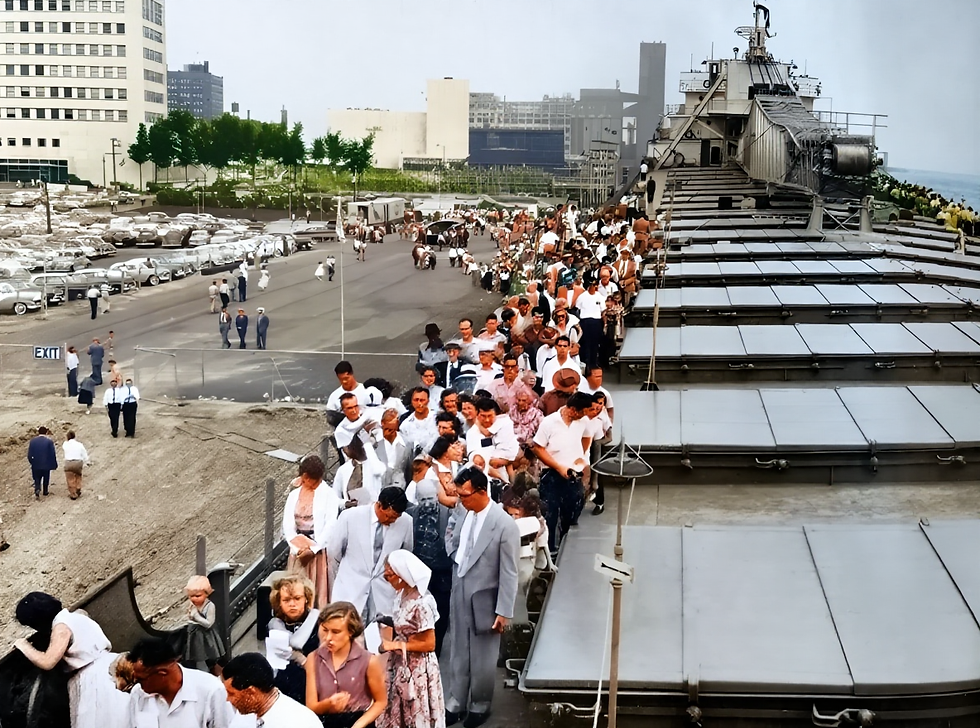
The Str. John G. Munson loomed over Civic Center Park in Detroit like a massive steel cathedral, its hull gleaming with deep bronze flashes in the afternoon sun. The scent of the river drifted through the warm air, mingling with popcorn, diesel, and the faint tang of machine oil that clung to the ship’s bones. Over six hours, 10,563 visitors streamed aboard—one every two seconds—forming a steady, living current of footsteps on metal decks. Families traced their hands along cool railings, children pressed their faces to portholes, and older visitors paused with a faraway look, remembering the century of Great Lakes shipping being honored that afternoon at Riverama. The Munson wasn’t just a ship on display; it felt like a living monument, breathing out stories with every creak of its hull.



While Detroit buzzed with celebration, Rogers City settled into the familiar rhythm of September. School doors swung open with a sigh, releasing the comforting scent of chalk dust, floor wax, and the crisp bite of autumn air. Fourteen hundred students returned to their classrooms, their voices echoing down hallways polished to a mirror shine. This year, new sounds joined the chorus—Spanish phrases rolling off tongues for the first time, replacing the quiet formality of Latin. Louise Kellar guided students through both Spanish and English, her voice warm and steady. Marion Mundt brought gentle energy to the elementary classrooms, George Schneider added his thoughtful cadence to English lessons, and Julian Brandou filled the science rooms with the sharp, clean smell of experiments waiting to happen.

Familiar footsteps returned too. Martha Klinsmann resumed her place at the chalkboard, her precise handwriting already filling the mathematics room. Lucille MacArthur’s laughter echoed from the gym as she encouraged her students. And from the band room came the bright, brassy swell of music—Delmar Conley was back, baton in hand, after his service in the Army.
In the hallways, a team of monitors stood ready, badges gleaming under the fluorescent lights. Captain Kathleen LaLonde moved with calm purpose, ensuring lockers were tidy, halls quiet, and newcomers guided with a reassuring smile. Her name showed up once more on the list of senior class officers as Secretary—joining President Gary Lamb, Vice President Wallace Wagner, and Treasurer Patricia Kelley—each stepping into their roles with a blend of pride and anticipation. The Student Council, led by President Ervin Mulka, was busy bridging the gap between faculty and students while discussing issues relevant to school life.


On Friday nights, the town pulsed with a different kind of energy. The Rogers City Hurons opened their football season with a clean 14–0 victory over Charlevoix. The air smelled of damp grass and concession-stand hot dogs, and every cheer rose like a warm gust into the cool evening sky. Captain Norman Makowski guided a team that played with determination all season, ending with a 5–3 record and outscoring their opponents 147 to 57. The crack of helmets, the thud of cleats, the roar after each touchdown—those sounds stitched themselves into the fabric of the town’s memory. Tom Paulus earned All-State third team honors, while Ron Idalski and Mark Smolinski received honorable mention, their names echoing proudly through the bleachers long after the final whistle.




After the games, headlights lined up outside Taylor’s Graystone Café. Inside, the air was thick with the smell of frying burgers, fresh coffee, and the sugary sweetness of milkshakes. Pops Taylor had built something new on US‑23—a warm, bustling place where teenagers replayed every moment of the game, laughter bouncing off the walls. No one knew then that the café would evolve into Kortman’s Restaurant and become a fixture of Rogers City for decades; in that moment, it was simply the place where memories were made.

At the Rogers Theater, the marquee lights flickered against the sidewalk as crowds gathered to see East of Eden. Inside, the screen glowed with James Dean’s restless, magnetic presence. Teenagers watched him with wide eyes, sensing in him a reflection of their own hopes and uncertainties. Two weeks later, news of his death swept through town like a sudden cold wind. The grief was sharp and bewildering; how could someone who seemed to burn so brightly be gone so soon? For many, it was the first time the world felt fragile.


Amid the swirl of school days, football nights, and movie-house dreams, a quieter moment of pride unfolded. Roger Hoffer of Explorer Post 145 stood tall at his Court of Honor ceremony, receiving the rank of Eagle Scout. The room was filled with the rustle of uniforms, the warm glow of candles, and the steady applause of families and Kiwanis Club sponsors. The badge pinned to his chest symbolized years of dedication, service, and perseverance—a milestone that shone as brightly as any touchdown under Friday night lights.

Together, these scenes—crowded ship decks humming with wonder, school hallways alive with new beginnings, football fields roaring with triumph, cafés glowing with laughter, movie screens flickering with dreams, and a young scout standing proudly at attention—wove themselves into a single season of memory. A season where Rogers City felt alive in every sense: the sound of footsteps and cheers, the scent of autumn and river air, the taste of milkshakes and victory, the sight of a community growing, and the feeling of time moving forward while holding tight to the stories that shaped it.


Comments