June 1960

The refreshing June air carried that unmistakable feeling of promise as eighty‑eight seniors of the Class of 1960 took their seats, the high school alive with proud families, bouquets of flowers, and the soft rustle of graduation gowns. For a moment, the world seemed to pause around them. They were no longer just students, they were young men and women standing at the threshold of everything ahead. When Dr. Gerald L. Poor of Central Michigan University stepped to the podium to deliver his address, “The Big X,” the room settled into a hush. His words seemed to lift the graduates a little higher in their chairs, reminding them that the choices they made from here on would shape the long roads stretching out before them.

Then came the voices from within their own ranks: Class President Joyce Gilbertson speaking with warmth and conviction, Salutatorian Faith Hornbacher offering gratitude shaped by years of shared effort, and Valedictorian Sharon McLennan reflecting on the friendships, trials, and triumphs that had carried them to this day. Their words felt like a final gift to their classmates, one last moment of unity before everyone embarked on new beginnings.


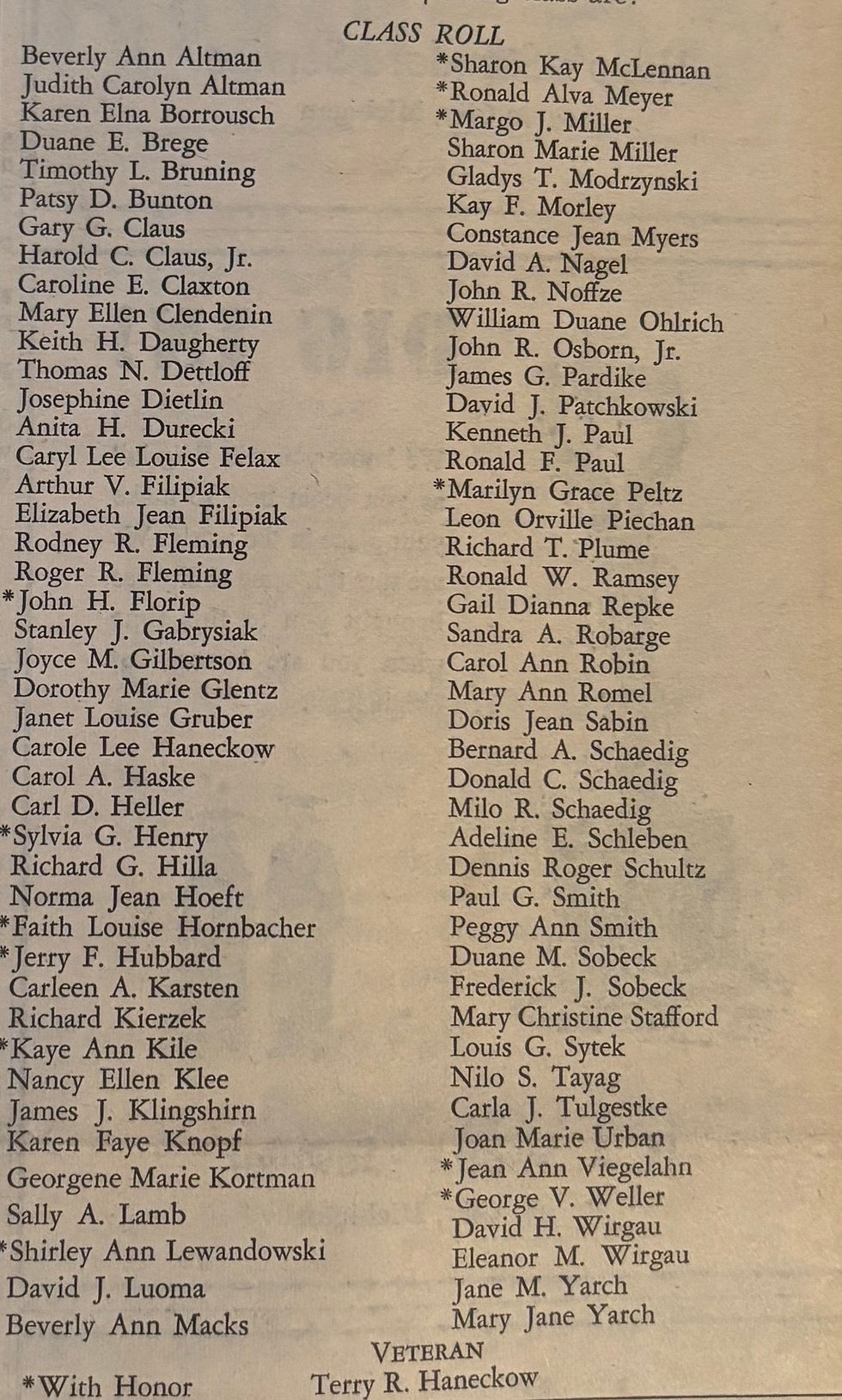


After the diplomas were handed out and the applause faded, the graduates spilled into the hallways with the same excitement they’d carried since childhood. They clutched fresh copies of Perannos, eager to gather signatures and scribbled messages from friends who had shaped their high school years. The yearbook itself was a labor of love, carefully assembled with care by Editor Ronald Meyer, Sponsor George Schneider, and a dedicated staff who spent the year capturing the heartbeat of Rogers City High School. Its pages held everything: the teams that battled on the courts and fields, the clubs that filled the school with purpose, the candid snapshots of everyday life in the hallways. It was a book of memories, but also a reminder of how much life they had lived together.


Earlier that morning, the courthouse square had been transformed into a small outdoor gallery as art students, guided by art instructor Wilfred Horning, displayed their work beneath the summer sun. Oil paintings, chalk drawings, poster paints, pencil sketches, watercolors, and intricate string designs fluttered lightly in the breeze. Parents and neighbors wandered from table to table, admiring the creativity of young artists who were just beginning to discover their own voices.


Across town, a different kind of new beginning was taking shape. Merlin Pardike, who had lost his general store to a devastating fire the year before, stood proudly beside the freshly painted pumps of Pardike’s Sinclair Service at the corner of Fourth and Erie. The former Ray’s Shell Station had been given a new life, and Pardike welcomed the community to a three‑day grand opening celebration, a testament to his resilience and ability to turn loss into opportunity.


Meanwhile, Main Street came alive with the annual Little League parade, a tradition that never failed to stir excitement. Little League Queen Debra Johnson, a bright‑eyed fifth grader from St. John’s Lutheran School, rode at the front in a gleaming convertible, her court—Wendy Ries, Linda Crow, Lynn Zempel, Brenda Osborn, and Betty Buza—smiling beside her. Behind them marched the Boy Scouts and Girl Scouts, followed by the Rogers City Community Band whose music drifted warmly through town. Then came the teams, boys in crisp uniforms walking with the proud swagger of athletes ready for summer glory.


At the ball fields, Little League President William Ransom tossed the first pitch to City Manager Charles McKee to open the majors game between the Giants and Indians. Moments later, John Blaskey threw the first pitch to Mayor James Brackenbury to begin the minors game between the Braves and Sox. The crack of the bat, the cheers from the crowds, the dust rising from the infield—it all signaled the start of another season filled with hope. Meanwhile, local service organizations continued their tireless fundraising for new Little League facilities, inching closer to their goal with every bake sale, raffle, and donation jar.
And while Rogers City celebrated at home, one of its own was already crossing the ocean. Seventeen‑year‑old Millicent Raymond, soon to be a senior at Rogers City High School, departed aboard the MS Seven Seas from Montreal, bound for Germany as part of the American Field Service foreign exchange program. Her summer home would be with the family of Mr. and Mrs. Reinhard Kimmel of Lambrecht, nestled in the Rheinland Pfalz region fifty miles north of the French border. Siblings Renate, Karl, and Ina—ages twenty‑two, seventeen, and sixteen—would be her companions as she explored a new culture, new language, and new way of life. Friends and classmates imagined her writing letters from faraway towns, gathering stories she would bring back to Rogers City upon her return.


Comments