August 1960: From Rogers City to the Olympics: The Story of Dave Gillanders

Every great story has a beginning, and for Olympic bronze medalist Dave Gillanders, part of that beginning was written right here in Rogers City.
John David "Dave" Gillanders was born on May 18, 1939, to Donald and Catherine (Schauber) Gillanders in Schenectady, New York. When Dave was still a little boy, the family packed up and moved to Rogers City, where his father went to work as an engineer at Michigan Limestone's Calcite quarry. For a number of years, the Gillanders family called this community home. Dave walked our streets, grew up in the shadow of the great limestone operation that has defined our town for generations, and lived within sight of the vast blue waters of Lake Huron. By the end of the 1940s, the family had moved downstate to Royal Oak, but the boy who once lived among us was about to embark on a remarkable journey.

What makes Dave's story so inspiring is that he was not a natural-born champion. He spent much of his youth in the water, taking Red Cross swimming lessons and attending YMCA camp every summer. He loved swimming, but there was one problem: he never figured out how to breathe while doing it. As he later recalled, "I could swim under water or on the surface for as long as I could hold my breath." Imagine that: a future Olympian who, for years, could only swim as far as a single gulp of air would carry him.
Then, around junior high school age, during another summer at YMCA camp, something finally clicked. He learned to turn his head to the side and take a breath. That simple breakthrough opened up a whole new world. Almost overnight, Dave's confidence in the water began to soar.
Even so, competitive swimming wasn't part of his plans. When he arrived as a freshman at Dondero High School in Royal Oak, students were given a choice between gym class and swimming. Dave, who never cared much for gym, chose the pool. It was a small decision that would change his life.
By his sophomore year, he had earned a spot on the junior varsity swim team and helped his squad capture a conference championship. Then, before his junior year, fate stepped in once again. His coach returned from a national coaches meeting with something new: a brand-new stroke called the butterfly. Few swimmers had ever tried it. Dave threw himself into learning it, practicing again and again until he became the most skilled butterfly swimmer on the team.
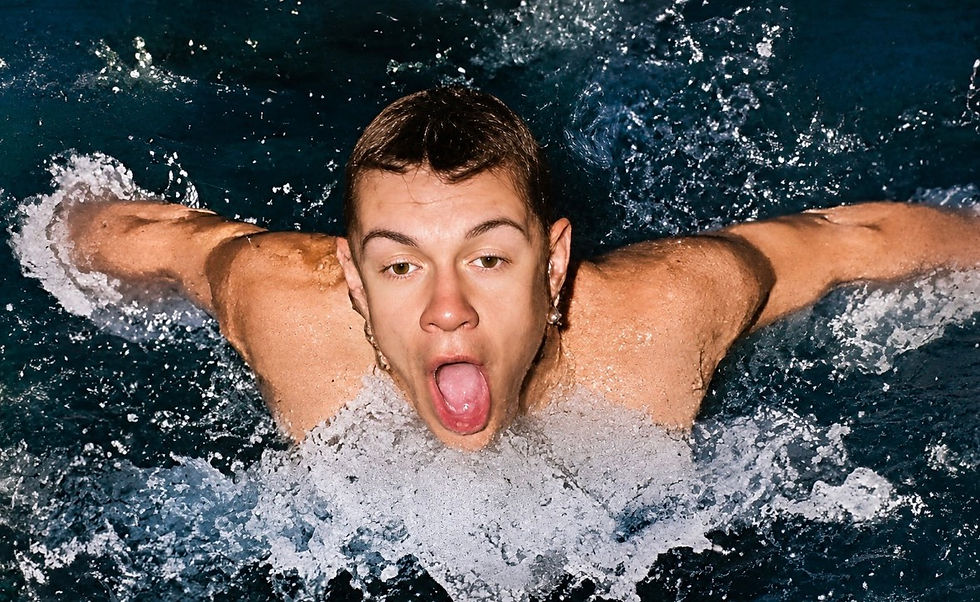
The hard work paid off in spectacular fashion. As a senior, Dave set a state record and won the state championship. His time of 57.5 seconds ranked him fifth fastest in the United States, and suddenly universities across the country were calling. The boy who once couldn't breathe while swimming had become one of the best young swimmers in America.
Dave graduated from Dondero in 1957 and chose the University of Michigan, drawn by both its outstanding swimming program and its excellent engineering school. He proved he could excel at both. In 1959, he won NCAA individual titles in the 100- and 200-yard butterfly and helped the Wolverines win the NCAA championship in the 400-yard medley relay. That same year, at the Pan American Games in Chicago, he won the gold medal in the 200-meter butterfly, defeating Mike Troy, the top-ranked swimmer in the nation.

In 1960, Dave faced the biggest test of his life: the U.S. Olympic Team Trials. Finishing second to Troy in the 200-meter butterfly, he earned his place on the United States Olympic team. At just 21 years old, he boarded a chartered turbo-prop plane for a 21-hour flight to Rome, Italy. He later laughed about the journey, remembering how the athletes removed the armrests between seats and took turns sleeping across the rows and on the floor, something that would never be allowed on a regular commercial flight.

In Rome, on the world's grandest stage, Dave Gillanders swam his way onto the Olympic podium, winning the bronze medal in the 200-meter butterfly behind Mike Troy and Australia's Neville Hayes. True to the spirit of a champion, he wasn't fully satisfied. He admitted being "quite disappointed" that he had swum 1.5 seconds slower than his time at the trials. That drive to always do better was exactly what had carried him so far.

Yet Dave's greatest legacy may be what he did after the Olympics. He never stopped learning. He earned his bachelor's degree from Michigan in 1962, his master's in 1963, and a PhD in electrical engineering in 1972. Perhaps inspired in part by the father who once worked as an engineer at the Calcite quarry, Dave devoted his life to engineering and to teaching others. He became a professor of electrical engineering at Texas A&I University (now Texas A&M University-Kingsville) and Arkansas State University, retiring after 30 years in the classroom.

And he never left the water. For more than 30 years, Dave competed in U.S. Masters Swimming, consistently placing in the top ten of his age group. In 1986, at an age when many people have long since hung up their swimsuits, he set a Masters world record in the short course 100-meter butterfly for the 45–49 age group. His message was clear: age doesn't have to stop you from doing what you love.
His achievements earned him lasting honors, including induction into the Royal Oak High School Hall of Fame in 1996 and election to the University of Michigan Athletic Hall of Honor in 2004.
Dave Gillanders' story reminds us that champions aren't always born; they're built, one breath, one stroke, and one choice at a time. A boy who once struggled to learn to breathe in the water, who chose the pool simply to avoid gym class, went on to stand on an Olympic podium and inspire students for three decades. For every young person in Rogers City wondering how far their dreams might take them, Dave's journey offers a powerful answer: farther than you can imagine.


Comments