October 1959

As summer slipped into fall and the Lake Huron wind picked up that familiar edge, Rogers City High School began to hum with the restless energy of homecoming week. Every afternoon, long after the final bell echoed down the halls, clusters of students gathered to transform piles of lumber, chicken wire, and crepe paper into parade floats that carried the pride of their classes and clubs. Laughter rose over the sound of staplers and paintbrushes, and the smell of fresh paint mixed with the crisp autumn air. Ballots were cast in homerooms and hallways, each vote helping shape the court that would stand at the center of the celebration. When the counting was done, the representatives emerged: juniors Robert Fairbanks and Margaret Foley, sophomores Thomas Bruning and Laurel Erke, freshmen Jerry Bannon and Barbara Bunton, and the king and queen, Dennis Schultz and Margo Miller.

By 7:15 on Friday evening, Main Street was lined with neighbors bundled in jackets, alumni returning home, and families staking out their favorite viewing spots. The parade stepped off with the Rogers City High School band, their brass notes bouncing off storefront windows. Behind them came the floats, pulled by shiny new automobiles loaned from local dealerships, their surfaces so polished they reflected every streetlight. Members of the pep club rode in the beds of pickup trucks, waving pom‑poms and shouting cheers, warming the crowd with their enthusiasm as much as with their smiles.


At Gilpin Memorial Field, the Hurons faced their longtime rivals, the Alpena Catholic Central Thunderbolts. The game was hard‑fought, and though Rogers City fell 19–6, the loss didn’t dim the spirit of the night. Students streamed back to the high school gym, where the homecoming dance awaited beneath soft lights and streamers. On stage, the king and queen were crowned, Queen Margo settling onto a throne draped in blue and silver as her court gathered around her. Music filled the gym as the dance carried on late into the night, becoming one of those evenings that lingers in memory, warm and glowing.


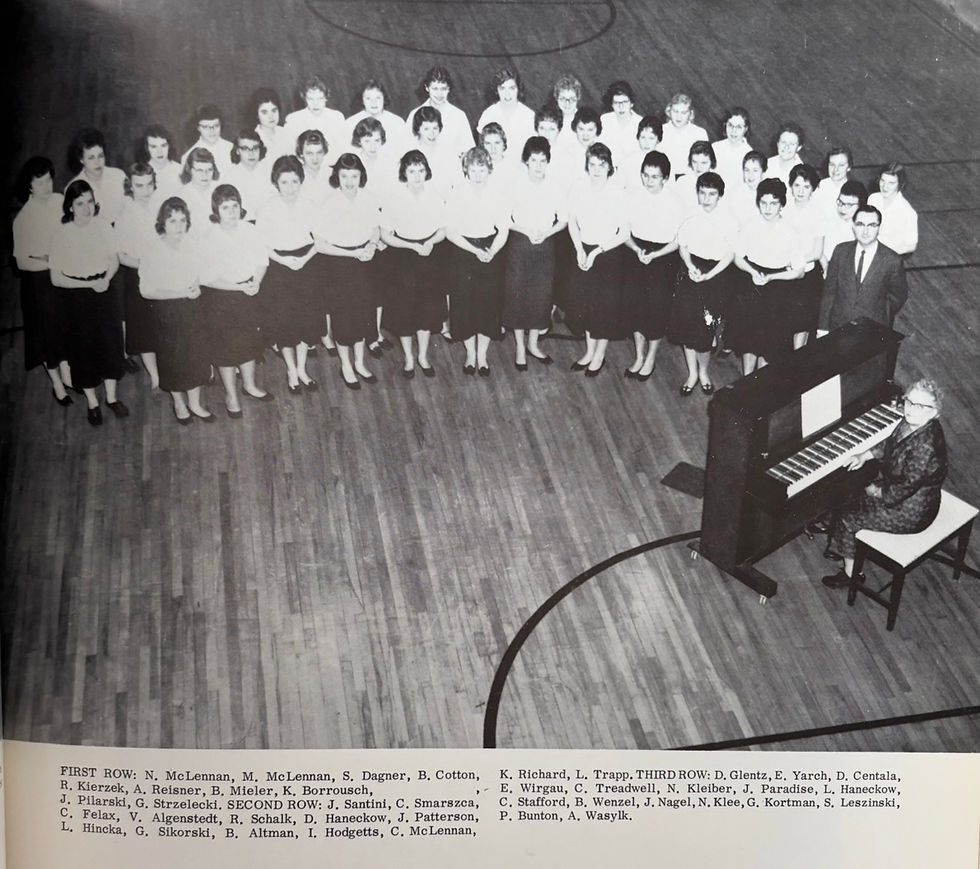
Beyond homecoming, the school year was finding its rhythm. Students were joining clubs, discovering new interests, and stepping into leadership roles. The senior class elected Joyce Gilbertson as President, Jerry Hubbard as Vice President, Margo Miller as Secretary, and Duane Sobeck as Treasurer. Others gravitated toward the student council, pep club, hall monitors, varsity club, Girls’ Athletic Association, Future Homemakers of America, school librarians, the Audio-Visual Club, Jets Science Club, Ski Club, and the Girls’ and Boys’ Glee Clubs. Whether your passion was athletics, science, performance, leadership, or service, there was a place to belong, a place to grow.


Meanwhile, downtown Rogers City had its own excitement. At the Rogers Theater, crowds gathered for the showing of Anatomy of a Murder, the acclaimed film starring Jimmy Stewart. The movie carried a special local connection: its Assistant Camera Operator, Robert Uhl, was born in Rogers City in 1913, the son of beloved local photographer Henry Uhl. After the family moved to Los Angeles, Robert found himself surrounded by the film industry. He worked for Technicolor, then for Walt Disney Studios, contributing to training films during World War II. Anatomy of a Murder, based on the bestselling novel by Michigan Supreme Court Justice John Voelker (writing as Robert Traver), was filmed across the Upper Peninsula—Big Bay, Marquette, Ishpeming, Michigamme—places rugged and atmospheric enough to match the story’s tension.


In April 1959, Robert invited his aunt and uncle, Harry and Betty Whiteley, to visit the courthouse set in Marquette. They watched scenes being filmed and met Director Otto Preminger, Cinematographer Sam Leavitt, actor Jimmy Stewart, and musician Duke Ellington, who was composing the film’s unforgettable score. Harry, editor of the Presque Isle County Advance, photographed the visit and published the images in the paper, building anticipation for the film’s premiere at the Rogers Theater, where it played for five nights to packed crowds.


As October deepened, Halloween arrived with its own charm. Children filled the sidewalks in costumes ranging from classic witches and ghosts to the new mass‑market boxed outfits sold at local stores including television heroes, western stars, and Disney characters. Adults joined the fun too; at Lucky Strike Lanes, league bowlers held a Halloween party where costumes were encouraged, turning an ordinary night of bowling into something festive and unforgettable. And for those who preferred staying home, a new television program was causing a stir. The Twilight Zone, hosted by Rod Serling, had begun airing on CBS, offering eerie, thought‑provoking stories that lingered long after the screen went dark.


Comments