top of page
Search

October 1956

The first weeks of a new school year always carry a certain electricity—fresh notebooks, crisp autumn air, and the sense that anything might happen. At Rogers City High School, that feeling was everywhere as students poured back into the halls, eager to join clubs, reconnect with friends, and step into roles that would shape their year.


Rogers City High School

Class elections set the tone, as the senior class chose the leaders who would guide them through their final year together. Roger Fleming took on the mantle of president, steady and confident. At his side stood vice president Catherine Thornley, secretary Beverly Treadwell, and treasurer Joan Sobeck—each ready to leave their mark. James Quinn and Ruth Hamilton, longtime pillars of the school community, stepped forward as class sponsors, offering the kind of guidance only experience can give.


The Senior Class officers are President Roger Fleming, Vice President Catherine Thornley, Secretary Beverly Treadwell, and Treasurer Joan Sobeck, 1956
Senior Class President Roger Fleming, 1956
Senior Class Vice President Catherine Thornley, 1956
Senior Class Secretary Beverly Treadwell, 1956
Senior Class Treasurer Joan Sobeck, 1956
Senior Class Sponsor James Quinn, 1956
Senior Class Sponsor Ruth Hamilton, 1956

Representing the seniors on Student Council were Alan Claus, Anneli Suominen, Kathleen Bannon, and Neil Vogler, with Larry Quade elected as council president. Their voices would help shape the school’s direction, carrying forward the hopes of their classmates. Some joined social groups like the Pep Club, Varsity Club, Girls' Athletic Association, Future Homemakers of America, Photography Club, and Audio-Visual Club, while others took on roles writing for the school newspaper, the School Static, or serving as Hall Monitors or School Librarians.


Rogers City High School Student Council, 1956-57
Student Council President Larry Quade, 1956
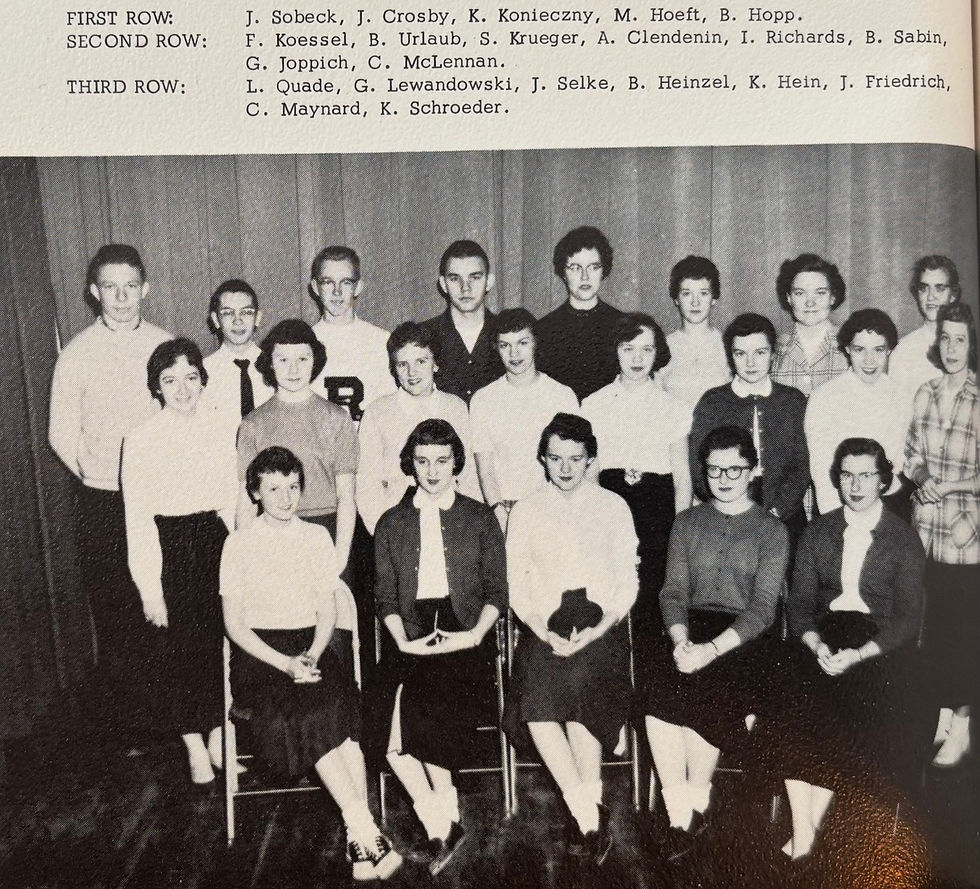
Rogers City High School Pep Club, 1956-57
Pep Club President Jill Crosby, 1956
Rogers City High School Hall Monitors, 1956-57
Hall Monitor Captain Janet Flemming, 1956
Rogers City High School Varsity Club, 1956-57
Rogers City High School Girls' Athletic Association, 1956-57
Rogers City High School Future Homemakers of America, 1956-57
Rogers City High School Librarians, 1956-57
Rogers City High School Photography Club, 1956-57
Rogers City High School Audio-Visual Club, 1956-57
Rogers City High School Static Newspaper Staff, 1956-57

But nothing brought the school together quite like homecoming. For one week, Rogers City transformed. The marching band—polished, proud, and unmistakably spirited—led the parade down Main Street, their music echoing between storefronts as families lined the sidewalks. Behind them rolled eight floats, each one bursting with color and creativity, crafted by classes and student organizations who had spent late nights painting, hammering, and dreaming.


Rogers City High School Band, 1956-57
Rogers City High School Majorettes, 1956-57
Rogers City High School Girls' Glee Club, 1956-57
Rogers City High School Boys' Glee Club, 1956-57

By the time the parade reached Gilpin Memorial Field, the excitement was impossible to contain. At halftime of the Rogers City vs. St. Ignace football game, the Glee Club claimed first prize for their float, earning cheers that could be heard across the field. Then came the moment everyone waited for: Homecoming Queen Sally Mulka receiving her bouquet of roses from Huron captain Mark Smolinski, cameras flashing like fireflies around them. The night ended the way all great homecomings do—with a dance in the high school gym, where the music was loud, the lights were soft, and memories were made without anyone realizing it.


Homecoming Queen Sally Mulka, 1956
Huron Football Captain Mark Smolinski, 1956

Beyond the celebrations, the school year brought meaningful change. A new state law requiring anyone under 18 to complete driver’s education before receiving a license meant Rogers City High School added a permanent driver training program. Chuck Owens stepped in as instructor, guiding students through the rules of the road and the responsibilities that come with freedom. Michigan Limestone supported the effort by loaning their Saf‑T‑Rater, a device used to test depth perception and reaction time before students ever touched the wheel. In return, Owens agreed to test drivers at the Calcite plant—a partnership that reflected the close-knit nature of the community.


Rogers City High School driver training dual-control car, 1956
Driver training instructor Chuck Owens guides Joanne Hornbacher on operating the depth perception test with Saf-T-Rater equipment borrowed from Michigan Limestone, while Julie Paradise waits her turn and Stan Modrzynski reviews the results, 1956
Driver training students Stan Modrzynski, Julie Paradise, and Joanne Hornbacher practice with the Saf-T-Rater equipment, 1956

Michigan Limestone’s commitment to Rogers City didn’t end there. In a gesture that blended history with hope for the future, the company donated its former main office building, vault, and three‑car garage on four lots on Woodward Avenue to the city for use as a municipal building. At a special session of the city council, Joseph Valentin, vice president of Michigan Limestone, formally presented the property—an act that symbolized the enduring bond between the company and the town it helped build.


Michigan Limestone donated its former main office building, vault, and three-car garage to Rogers City, all located on four lots along Woodward Avenue, 1956
Joseph Valentin, vice president of Michigan Limestone, hands over the keys to the company’s former main office building to Mayor Robert Crittendon, while William Crow, Ray Sabin, William Froelich, Cecil Hodgetts, and Charles McKee watch, 1956

And beyond the school and city limits, the world was buzzing with political energy. Election season swept through northern Michigan, bringing candidates and crowds to local venues. Detroit Mayor and Republican candidate for Michigan Governor Albert Cobo spoke at the St. Ignatius Catholic Church auditorium, drawing residents eager to hear his message. In addition, the Vice President of the United States, Richard Nixon, arrived in Alpena, delivering a campaign speech from the steps of Alpena City Hall as WHAK radio captured the moment for listeners across the region.


Albert Cobo, the Mayor of Detroit and a Republican candidate for Governor of Michigan, 1956
Albert Cobo Campaign Ad, 1956
Vice President Richard Nixon made a campaign stop in Alpena, drawing a large crowd of local residents and receiving live coverage from local radio station WHAK, 1956


Recent Posts

See All

Comments


bottom of page