March 1955
- charliebunton
- Jan 29
- 3 min read

Spring drifted into Rogers City like a long‑awaited guest, slipping gently over the rooftops and thawing the last memories of a winter that had felt endless. Windows cracked open to let in the first mild breeze, carrying the scent of damp earth and sun‑warmed pine. People stepped outside and lifted their faces to the light, letting the sunshine touch skin that had forgotten its warmth.

For many, spring meant one thing above all: the Rogers City Country Club was open again. The fairways, still soft from melting frost, beckoned golfers eager to hear the satisfying thwack of a well‑hit ball echo across the course. Mr. and Mrs. Edward Arscott arrived with their friends, Mr. and Mrs. Ferris Parsons, their laughter carrying across the parking lot as they joined dozens of others celebrating both the weather and the unveiling of the club’s new clubhouse. The air tasted fresh, almost sweet, as if the whole town were exhaling at once.

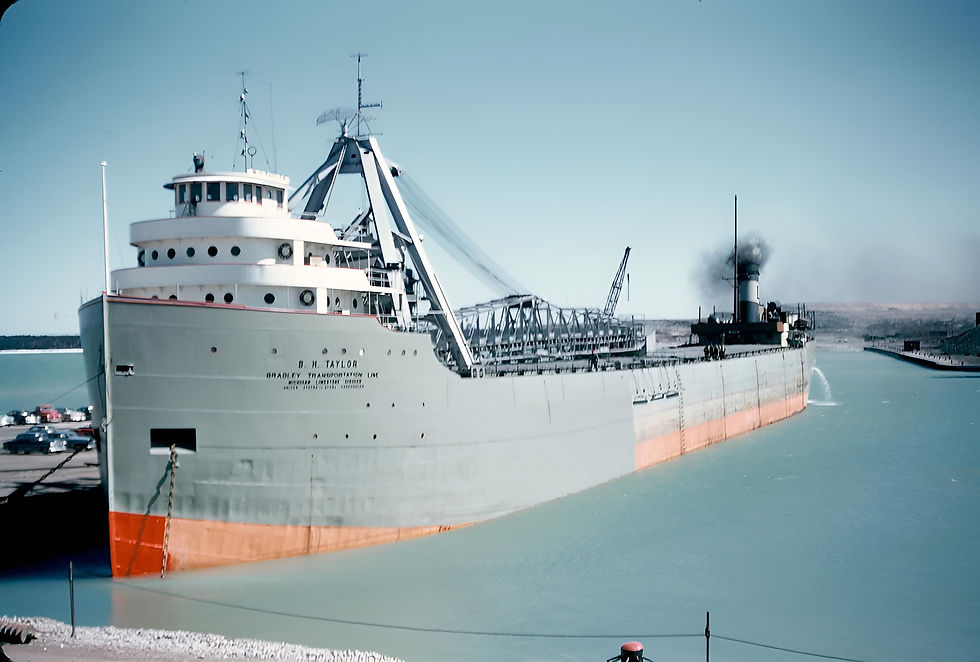
Down at the Calcite plant, spring carried a different rhythm—the deep, resonant hum of engines waking from their winter slumber. The Str. B.H. Taylor, newly reboilered and gleaming with its powerful 4,000‑horsepower turbine, stood ready for the season ahead. Workers moved with a sense of pride and purpose, their boots clanging against metal decks still cool from the night. The announcement of John P. Kinville’s promotion to vice president added another spark of optimism. A graduate of Alpena High School, Kinville had started as an accountant at Calcite in 1916.



In town, Ferris Parsons—when not on the golf course—was celebrating triumphs of his own. His photographs had earned several awards at the Photographers Association of Michigan convention in Lansing. Portraits of familiar faces—Marie Misiak, Candace Parsons, Jeanne and Susan O’Callaghan, Nellie Bullock, Mrs. Robert Wozniak, and Mr. Teller—captured moments of quiet beauty, each image holding a story in the curve of a smile or the glint of light in an eye.

At Rogers City High School, the halls buzzed with the energy of springtime accomplishments. The staff of The School Static, guided by editor‑in‑chief Linda Quinn, hurried between classrooms and events, pencils tapping and notebooks filling with stories. The Huron varsity basketball team, after a tough season, finished with a triumphant burst—an 82‑point game, the highest in school history. The gym had roared that night, the crowd rising to its feet as Tom Paulus scored 25 points and Bill Shay added 18, the sound of each basket echoing like a promise of better seasons ahead.


The Future Homemakers of America returned from their state convention in Grand Rapids with stories of lively discussions, elegant fashion shows, and a banquet filled with laughter. Meanwhile, the high school band, under Stephen Wolf’s steady direction, earned an “excellent” rating at the district festival in Traverse City. Their music—bright, brassy, and full of heart—seemed to mirror the season itself.


But perhaps nowhere was spring felt more vividly than in the imaginations of the town’s boys. Rogers City had fallen headfirst into a Davey Crockett whirlwind. After the Disney miniseries and the hit song swept across radios, the local woods transformed into untamed frontier. Backyards became forts, and every vacant lot turned into a battleground for heroic last stands. Boys marched through the brush in coonskin caps and fringed jackets, their wooden “Old Betsy” rifles slung proudly over their shoulders. Even as the sun grew warmer, they refused to shed their heavy faux‑fur hats, determined to stay in character as long as daylight allowed. Their shouts echoed through the trees—half play, half legend—as they chased imaginary bears, defended the Alamo, and carved out their own wild territories.



1 Comment